The Sierra Nevada and Alpujarra: A Classified High Risk Zone
The Barranco del Poqueira and the surrounding Alpujarra municipalities are officially classified as Zona II — the highest risk category — under Spain’s Technical Building Code (CTE DB-HS6, Appendix B). This classification is based on actual radon measurements in buildings combined with geological mapping by the Consejo de Seguridad Nuclear (CSN).
The following municipalities in and around the Barranco del Poqueira and wider Alpujarra are listed in Zona II:
Barranco del Poqueira and immediate surroundings: Pampaneira · Bubión · Capileira · La Taha · Pórtugos · Busquístar · Pitres · Soportújar
Wider Alpujarra Alta (Granada): Alpujarra de la Sierra · Almegíjar · Bérchules · Cádiar · Cástaras · Juviles · Lobras · Murtas · Nevada · Trevélez · Turón · Ugíjar · Válor
Sierra Nevada and surrounding areas: Güéjar Sierra · Monachil · Pinos Genil · Quéntar · Cenes de la Vega · Lugros · Alquife · Baza · Caniles · Dólar · Ferreira · Gor · Guadix · Huéneja · Jerez del Marquesado · La Calahorra · Lanteira · Valle del Zalabí
In Zona II municipalities, residents on ground and first floors are exposed on average to around 200 Bq/m³ — nearly three times the national average — and more than 10% of buildings exceed Spain’s 300 Bq/m³ reference level. The underlying geology of metamorphic and igneous rocks throughout the Sierra Nevada, combined with the highly fractured nature of local slate and schist, creates ideal conditions for radon migration into buildings.
What is Radon and Why is it Bad for Your Health?
Radon is a naturally occurring radioactive gas — specifically Radon-222 — produced by the radioactive decay of uranium-238 in rock and soil. It is colourless, odourless and tasteless. It cannot be detected by any human sense.
Radon is exceptionally heavy — with an atomic mass of 222, it is roughly 8 times heavier than air — which means it sinks and accumulates at floor level and in low spaces. This is critical to understanding both the risk and the solutions.
The Decay Chain
Radon-222 itself is not the primary danger. The hazard comes from its radioactive decay products — the sequence of elements it transforms into as it decays toward stable lead:
| Element | Half-life | Decay type |
|---|---|---|
| Radon-222 | 3.8 days | Alpha |
| Polonium-218 | 3 minutes | Alpha |
| Lead-214 | 27 minutes | Beta |
| Bismuth-214 | 20 minutes | Beta |
| Polonium-214 | 0.0001 seconds | Alpha |
| Lead-210 | 22 years | Beta |
| Bismuth-210 | 5 days | Beta |
| Polonium-210 | 138 days | Alpha |
| Lead-206 | Stable | — |
The early steps of this chain — from Po-218 to Po-214 — happen within about an hour. These short-lived decay products are electrically charged and attach to airborne particles and lung tissue when inhaled. Once lodged in the bronchial lining they continue firing alpha particles directly into lung cells at point blank range, causing DNA damage that can eventually lead to lung cancer.
This is why radon is more dangerous than simple external alpha radiation exposure — alpha particles cannot penetrate skin from outside, but when decay products are embedded in lung tissue the geometry changes entirely. There is no protective barrier.
Radon is itself a decay product — the immediate parent is radium-226, with a half-life of 1,600 years, which in turn descends through several intermediate decay steps from uranium-238, with a half-life of 4.5 billion years — roughly the age of the Earth. Both are essentially inexhaustible on any human timescale, permanently fixed as solids in the rock. The Sierra Nevada bedrock has been generating radon continuously since it formed, will continue to do so indefinitely, and no human intervention will change the source. The only question is whether the gas finds a path into a living space and whether it is then ventilated away.
Health Effects and Risk Figures
Radon causes no immediate symptoms — no headaches, no nausea, no detectable effects at any concentration. It is entirely insidious. The only established health effect is long-term lung cancer risk from cumulative exposure over decades.
The main causes of lung cancer globally, with estimated share of cases:
| Cause | Estimated % of lung cancers globally | Notes |
|---|---|---|
| Tobacco smoking | 80–90% | By far the dominant cause |
| Air pollution (PM2.5) | ~14% | Higher in heavily polluted countries |
| Radon | 3–14% | Higher in high-radon geology areas |
| Occupational exposure | 5–10% | Asbestos, arsenic, silica, diesel exhaust |
| Secondhand smoke | ~3% | Varies significantly by country |
Note: percentages do not sum to 100% as many lung cancers involve multiple contributing factors, and smoking interacts with other causes to multiply risk significantly.
Key figures based on international pooled epidemiological studies (WHO, Darby et al. 2005, Krewski et al. 2005):
- Lung cancer risk increases by approximately 16% for every 100 Bq/m³ of long-term average exposure
- “Long term” in these studies means approximately 30 years of continuous exposure at that level
- The combination of smoking and radon exposure is multiplicative — a current smoker in a high radon environment faces dramatically elevated risk compared to either factor alone
The following table shows lifetime absolute risk of dying from lung cancer by age 75, based on the Darby et al. 2005 collaborative analysis of 13 European case-control studies. Smoker figures include the background risk from smoking itself — radon adds incrementally on top of that.
| Scenario | Lifetime risk of lung cancer by age 75 |
|---|---|
| Non-smoker, low radon (~50 Bq/m³) | ~0.4% |
| Non-smoker, Zona II average (~200 Bq/m³) | ~0.6% |
| Non-smoker, 400 Bq/m³ | ~0.7% |
| Smoker, low radon (~50 Bq/m³) | ~10% |
| Smoker, Zona II average (~200 Bq/m³) | ~13% |
| Smoker, 400 Bq/m³ | ~16% |
The non-smoker figures show a real but modest increase with radon level. The smoker figures tell a starker story — and bear in mind that the Zona II average of 200 Bq/m³ is exactly the kind of long-term average a sealed bedroom with exposed bedrock could produce in this area.
The risk follows a linear dose-response relationship with no known threshold — any exposure carries some risk, which increases proportionally with concentration and duration.
When and Where Are Concentrations Highest?
The Chimney Effect — Isolated Rural Houses
An isolated house in the countryside behaves like a low-pressure chimney. Warm air rises through the building and escapes through gaps at the top, creating a slight negative pressure at floor level. This negative pressure actively draws soil gas — including radon — up through the floor from the ground below.
During the day, solar heating of the surrounding soil causes it to expand and exhale gas outward and upward away from the building. At night the soil cools, contracts, and the pressure differential reverses — soil gas is drawn inward and upward into the building.
In a village like those in the Barranco del Poqueira, the effect is amplified — the entire densely built village, with its interconnected walls, shared foundations and narrow streets, acts as a single large chimney drawing radon from the bedrock underneath. Individual buildings within the village may have local concentration spots significantly higher than measured averages suggest, particularly in lower floors and enclosed spaces.
Peak Conditions
Radon accumulates fastest under the following conditions, which frequently coincide:
At night: Solar heating stops, soil contracts, stack effect strengthens, air movement inside the house ceases, human activity that disturbs and dilutes air also stops. Levels typically peak between 2am and 7am.
During bad weather: Arriving low pressure weather systems reduce atmospheric pressure above the soil, allowing soil gas to migrate upward with less resistance. Rain and cloud cover also eliminate the solar warming effect that draws radon outward from the soil during the day.
In winter: Houses are sealed against the cold, ventilation is minimal, temperatures drive stronger stack effect, lighting the stove for example has a noticeable effect, and the soil is wetter which can increase radon migration.
The combination of a cold winter night with a low pressure weather system arriving, windows closed and air still, can produce concentrations many times higher than the seasonal average.
What Building Characteristics Make a House More Prone?
What Protects Against Radon
A well-constructed ground floor slab provides a substantial barrier. The typical sequence of protection layers — compacted fill, stone drainage layer, plastic membrane, concrete slab — slows radon migration dramatically. Each layer forces the gas to diffuse through a denser medium, and radon’s 3.8 day half-life means much of it decays before reaching the surface.
A thick concrete slab alone reduces radon entry significantly because radon must diffuse atom by atom through the dense alkaline concrete matrix. A polyethylene membrane beneath the slab adds another near-impermeable barrier. Stone drainage beneath the membrane serves a dual purpose — it drains moisture and creates a permeable layer that can be used for sub-slab depressurisation if needed.
Normal Ventilation
Even in buildings with moderate radon entry, normal ventilation cleans the air very effectively. Radon disperses rapidly in moving air — opening a window can reduce concentrations by 70-80% within 30 minutes. Once ventilated, it typically takes 4-5 hours for concentrations to rebuild to peak levels under closed conditions. This is why overnight accumulation in sealed bedrooms is the primary exposure concern.
Basements
Basements are particularly problematic for several reasons simultaneously: they have the most contact surface with soil and rock, they are at the lowest point where radon pools, they typically have minimal ventilation, the negative pressure drawing radon in is strongest at the lowest level, and people often use them as living spaces, workshops or bedrooms without awareness of the risk.
Direct Bedrock Exposure — A Specific Alpujarra Problem
The most significant radon risk factor in the Alpujarra — and one that is entirely absent from standard construction guides written for flat lowland sites — is direct exposure of bedrock within the living space.
Many houses in the steep terrain of the Alpujarra were built incorporating bedrock outcrops that could not be removed, particularly where heavy machinery could not manoeuvre. Exposed bedrock within a habitable room, particularly under or near sleeping areas, bypasses every protective barrier that standard construction provides.
The local slate and metamorphic geology of the Alpujarra is especially problematic in this respect. Slate appears visually solid and impermeable but its entire geological character is defined by cleavage planes — parallel layering created under directional pressure during metamorphism. These cleavage planes act as open channels for gas migration even where the surface looks perfectly intact. Rain events both increase the atmospheric pressure differential driving radon upward and physically cause cleavage planes to open and close, pumping radon into the building.
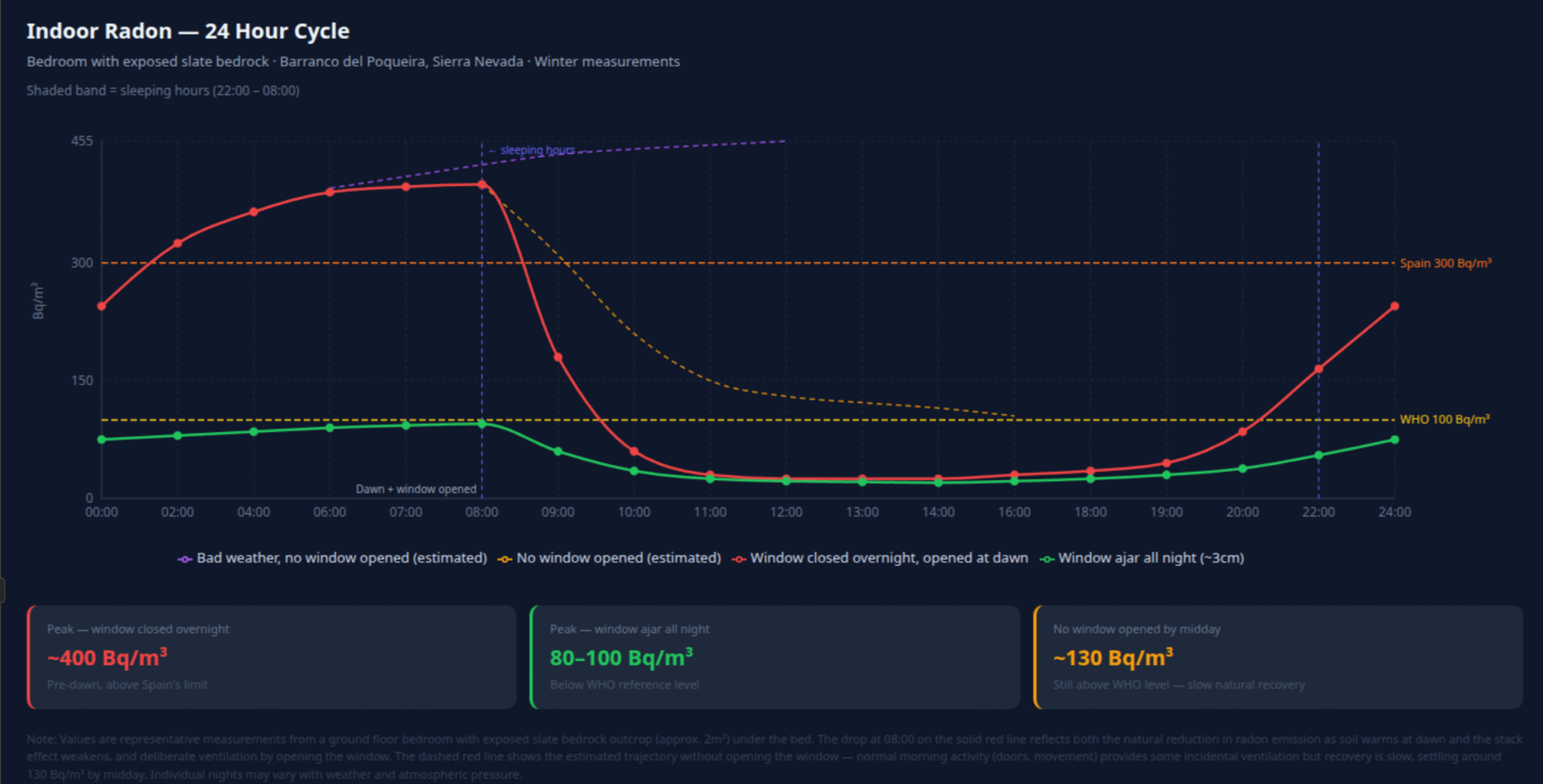
Personal observations suggest that a 2m² exposed bedrock surface under a bed with no concrete, membrane or other barrier can act as a direct radon chimney from the earth to the breathing zone of a sleeping person. Overnight readings directly above such an exposure reached peaks above 400 Bq/m³ — well above Spain’s 300 Bq/m³ reference level — under good-weather winter conditions, while daytime readings with normal ventilation were only 20-30 Bq/m³. These are amateur observations from a short measurement window and should be treated as indicative rather than definitive, but the pattern is consistent with what the underlying physics and geology would predict.
Legislation and Acceptable Levels
Spain
Spain was remarkably late to address radon — legislation only arrived in 2019. Royal Decree 732/2019 introduced section DB-HS6 into the Technical Building Code, establishing a reference level of 300 Bq/m³ as an annual average for habitable spaces. This was strengthened by Royal Decree 1029/2022 which transposed EU legislation and confirmed the 300 Bq/m³ annual average as the reference level for homes and workplaces.
Spain’s 300 Bq/m³ threshold is triple the WHO recommendation and at the maximum permitted under EU Basic Safety Standards. It applies to new buildings and renovations in classified zones, and creates obligations for workplace measurement in priority municipalities.
European Union
The EU Basic Safety Standards Directive (2013/59/Euratom) requires member states to establish national action plans and reference levels not exceeding 300 Bq/m³. Measurement protocols require a minimum of two months, with one year preferred for proper annual average assessment.
Reference levels across Europe vary considerably:
| Country/Organisation | Reference Level | Notes |
|---|---|---|
| WHO | 100 Bq/m³ | Maximum 300 if 100 not achievable |
| Denmark | 100 Bq/m³ | Legally binding for new buildings |
| Norway | 100 / 200 Bq/m³ | Two-tier system — action / maximum |
| Sweden | 200 Bq/m³ | |
| Finland | 200 / 300 Bq/m³ | New / existing buildings |
| UK | 100 / 200 Bq/m³ | Target / action level |
| USA (EPA) | 148 Bq/m³ (4 pCi/L) | |
| Canada | 200 Bq/m³ | |
| Spain | 300 Bq/m³ | |
| EU maximum | 300 Bq/m³ |
Typical Annual Average Levels
| Location | Typical Annual Average |
|---|---|
| Outdoor air (worldwide) | 10-15 Bq/m³ |
| USA national average | 50 Bq/m³ |
| Spain national average | ~40 Bq/m³ |
| Finland (houses) | 121 Bq/m³ |
| Norway average | ~90 Bq/m³ |
| Sweden (houses) | ~70 Bq/m³ |
| Zona II Spain (ground floor) | ~200 Bq/m³ |
Finland, Norway and Sweden have among the highest radon levels in the world due to their granite-dominated geology and the prevalence of basement construction. An estimated 450,000 Swedish homes, 200,000+ Finnish homes and 170,000 Norwegian homes exceed 200 Bq/m³.
Why Annual Averages Are Not the Whole Story
All regulatory reference levels and health risk calculations are expressed as annual averages. This is a practical simplification for population-level regulation, but it can significantly understate risk for individuals with strongly peaked exposure patterns.
The WHO itself recommends that measurement protocols link radon concentrations to individual mobility patterns — measuring in the rooms where people actually spend time, during the hours they actually occupy them. A person sleeping 8 hours per night in a bedroom that peaks at 400 Bq/m³ while their daytime levels are 20-30 Bq/m³ may have an annual average that appears acceptable, while their actual nightly exposure is well above every reference level.
There is legitimate scientific debate about whether repeated high-intensity exposures are more damaging than the same total dose delivered at lower continuous levels. The bronchial epithelial cells that are most vulnerable to radon decay products experience each night’s exposure fresh — repeated 400 Bq/m³ sleeping exposures may represent a different biological risk than the same annual dose delivered continuously at a lower level.
Radiation dose from radon is calculated using the ICRP dose coefficient of 6.9 × 10⁻⁶ mSv per Bq·h/m³. At 200 Bq/m³ for 8 hours of sleep, this gives approximately 0.011 mSv per night — meaning one chest X-ray equivalent dose approximately every 9 nights, delivered specifically to lung tissue via alpha particles which are biologically more damaging per unit dose than external radiation.
The practical implication: A continuous electronic monitor measuring actual exposure during actual sleeping hours provides more meaningful personal health information than a passive annual average detector, particularly in the Alpujarra where seasonal and diurnal variation is extreme.
What Can We Do About It?
Scandinavia Leads — Spain is Just Beginning
Finland, Norway and Sweden have been systematically addressing indoor radon since the 1980s, driven by the combination of high-radon granite geology, extensive basement construction and cold winters requiring sealed houses. These countries have developed a comprehensive toolkit of solutions, trained a professional mitigation industry, and incorporated radon protection into building codes decades before the rest of Europe.
Spain by contrast only introduced radon into building legislation in 2019. Awareness among builders, architects and the general public remains low. However the toolkit developed in Scandinavia translates directly to the Spanish context.
Ventilation — The Most Important Tool
Radon disperses extremely rapidly with ventilation. This is the most important practical fact. Opening a single window can reduce concentrations by 70-80% within 30 minutes. The gas does not linger, does not absorb into surfaces, does not accumulate in soft furnishings. Once it is flushed out it is gone — until the next buildup cycle begins.
Personal observations suggest that a window opened just 2-3cm — a small crack — can reduce overnight bedroom peaks from above 400 Bq/m³ to 80-100 Bq/m³. In practice, any continuous airflow at floor level where radon pools is highly effective.
Trickle Ventilation — Minimising Heat Loss
For year-round passive ventilation that does not sacrifice winter warmth, trickle vents offer an elegant solution. These are small controlled openings — typically 50-75mm duct through a wall — that allow a continuous low-level air exchange without the heat loss of an open window.
Key design principles for trickle vents in the Alpujarra context:
Position at floor level — since radon is heavy and pools at the bottom of rooms, low vents directly displace the highest concentration layer. A high window moves warm mixed air; a floor vent moves the radon-laden cold layer where it actually accumulates.
Opposing vents create cross-flow — an inlet on one wall and outlet on the opposite creates a sweeping flow across the floor rather than turbulent mixing. Ideally the inlet is positioned on the wall furthest from any bedrock exposure, so fresh air sweeps across the problem area toward the exit.
The longer the duct run, the better the pre-warming — incoming cold air travelling through 1-2 metres of duct embedded in a wall at room temperature picks up heat before entering. This is the same principle as Scandinavian earth-tube pre-tempering systems, achieved simply by routing the duct through the building fabric.
Closable with fine control — a sliding damper allows adjustment from fully closed on the coldest nights to fully open in mild weather, with intermediate positions for fine control.
In southern Spain the seasonal balance favours open vents — six months of warm summer when vents can remain open provide free cooling using cool dense night air. The mild Sierra Nevada winters mean the heat loss from a small trickle vent is modest compared to any heating system.
Door gaps as air paths — a gap under an interior door between rooms can serve as part of the ventilation flow path, allowing a single external inlet to ventilate multiple rooms. A standard undercut of 2-3cm across an 80cm door provides approximately 240cm² of airflow — more than adequate for typical duct sizes.
Sealing Bedrock Exposures
Where bedrock is directly exposed within the living space, sealing the surface can significantly reduce direct emanation:
Penetrating epoxy resin is the most effective product — it soaks into the rock surface, fills pore structure and cleavage planes, and cures to a gas-tight barrier. Standard surface paint offers almost no resistance to radon molecules. Two coats of penetrating epoxy, with special attention to visible cracks and the transition zone where rock meets floor, can reduce emanation from a sealed surface by 80-90%.
Fill cracks before sealing the surface — radon migrates primarily through cracks and cleavage planes rather than through intact rock. Flexible polyurethane sealant injected into visible cracks before the surface coat is applied is as important as the surface coating itself.
Covering with concrete and tiles is highly effective even without a membrane — a 10cm concrete slab over exposed bedrock, finished with tile and epoxy grout, adds multiple diffusion-resistant layers and can reduce emanation by 70-80% alone. Ceramic tile with epoxy grout at the joints provides near-impermeable coverage. This approach is more practical than attempting to remove large bedrock outcrops that are effectively structural.
The perimeter joints where bedrock meets the floor slab are as important as the main surface — these transitions are prime radon pathways and should be filled with flexible polyurethane sealant and sealed with epoxy before any surface treatment.
Professional Solutions — When to Call an Expert
For situations where DIY ventilation and sealing are insufficient, professional radon mitigation offers proven and highly effective solutions:
Sub-slab depressurisation is the standard professional solution for basement and ground floor radon problems. A pipe is drilled through the concrete slab into the stone drainage layer beneath, and a small continuously running fan creates negative pressure under the floor. This actively draws radon out from the soil and rock before it can enter the building, venting it harmlessly to the atmosphere above roof level. In houses with a stone drainage layer — which is standard good construction — a single pipe and fan can typically reduce radon by 80-99%. Active systems typically use only 20-40 watts continuously.
Passive depressurisation uses the same pipe through the floor but relies on stack effect and wind rather than a fan. Effective in many situations and uses no energy — ideal for solar-powered homes. Can be installed first and upgraded to active if passive suction proves insufficient.
Heat Recovery Ventilation (HRV) — known in Spain as VMC with recuperación de calor — continuously exchanges indoor air with fresh outdoor air while recovering 80-90% of the heat from the outgoing air. This is standard in modern Scandinavian construction and effectively eliminates radon buildup regardless of source. It is the solution of choice for new construction and major renovations, particularly where multiple rooms need treatment simultaneously. Units are available from manufacturers including Mitsubishi (Lossnay range) and many European specialists.
Basements specifically require professional assessment — the combination of multi-surface soil contact, deep below-grade position, typically limited ventilation options and often structural constraints makes basement radon remediation complex. A professional can assess the specific pathways and recommend the most effective combination of sub-slab depressurisation, wall sealing and ventilation.
Key Practical Summary
Radon is a real but manageable risk. The gas disperses immediately and completely with any airflow — it does not accumulate in materials, does not require decontamination, and leaves no lasting contamination. Every measure that improves ventilation or reduces entry is effective.
In priority order for an Alpujarra house with bedrock exposure:
- Measure first — a continuous electronic monitor (such as the RadonEye RD200) in the bedroom under normal sleeping conditions gives the most meaningful personal exposure data. A passive alpha-track detector (such as Radonova Radtrak³) run for 90 days in winter gives the legally meaningful annual average.
- Ensure sleeping rooms are ventilated at night — even a window cracked 2-3cm transforms the exposure picture. This alone may reduce risk to acceptable levels immediately.
- Install floor level trickle vents — a properly designed passive trickle vent at floor level on opposing walls provides continuous effective ventilation with minimal heat loss, eliminating the need for open windows in cold weather.
- Seal exposed bedrock — penetrating epoxy on visible surfaces, polyurethane in cracks, concrete and tile over large areas. Address the perimeter joints carefully.
- Consider sub-slab depressurisation if sealing and ventilation are insufficient — particularly relevant where bedrock underlies the slab and cannot be fully sealed from above.
- Consult a professional for basements, complex cases or where measurements remain above 200 Bq/m³ after basic mitigation measures.
How to Measure Radon in Your Home
The Standard Approach — Passive Alpha-Track Detectors
The legally recognised method for measuring radon in Spain and across Europe is the passive alpha-track detector — a small plastic device, typically the size of a matchbox, that is placed in a several rooms you spend more time in and left for a period of months. Radon diffuses passively into the device where its decay products leave microscopic damage tracks on a plastic film. The devices are then posted to a laboratory which counts the tracks under a microscope and returns an average concentration figure for each room.
Spain’s national radon measurements, which form the basis of the CSN risk maps, were made with track detectors exposed for a period of three to six months. Current Spanish legislation requires measurements for regulatory purposes — workplaces, new buildings in priority zones — to be conducted using accredited laboratory methods of this type, with a minimum exposure of two months and ideally a full year.
The attraction of passive detectors is their simplicity and low cost. They require no power, no setup, and no technical knowledge — you place them in the room, leave them, and post them off. Their limitation is equally clear: they produce a single average figure for the measurement period and reveal nothing about peaks, patterns or the conditions under which those averages were reached.
Why a Single Average Can Mislead in the Alpujarra
In most of northern Europe, where Finland and Sweden have developed their radon measurement culture over decades, the annual average is a reasonably stable and representative figure. Radon levels vary seasonally — concentrations are higher in winter than in summer due to strong convective air flow from soil into houses — but the variation is relatively predictable and correction factors are well established.
The Alpujarra situation is different in two important ways.
The first is the extreme seasonal contrast. Alpujarra summers bring long hot days, short warm nights, soil that is dry and warm and exhaling rather than drawing inward, and houses with windows and doors open around the clock. A passive detector run through July and August may record very little radon at all — not because the house is safe, but because the conditions that drive radon accumulation are largely absent in summer. The same house in a sealed winter bedroom is an entirely different picture. A measurement that spans summer months will substantially underestimate the annual risk weighted by actual sleeping hours.
The second is event-driven peaks. Bad weather in the Alpujarra is not a continuous background condition — it comes in episodes. A winter low-pressure system can sit over the Sierra Nevada for days or weeks at a time, driving sustained elevated radon levels that a passive detector will partially smooth into its running average. A measurement window that happens to miss these events will underestimate peak exposure. A measurement window that catches a prolonged bad-weather period may look alarming but actually be representative of the genuine worst case.
The Case for a Continuous Electronic Monitor
A real-time electronic monitor — of which the RadonEye RD200 is one of the better known consumer-grade options — records concentration continuously and shows you the full picture: overnight buildup, the response to opening a window, the spike during a storm, the low readings of a summer afternoon. It does not replace a long-term passive measurement for regulatory purposes, but for understanding your own exposure and testing the effect of mitigation measures, it provides information that a passive detector simply cannot.
The practical value is immediate. You can see within a single night whether your bedroom is accumulating radon while you sleep. You can open a window by 3cm and watch the reading fall within the hour. You can observe what happens during a period of bad weather. None of this is possible with a passive detector that yields one number months later.
The limitation of short-term electronic monitoring is the same as any short-term measurement — a few days captures a snapshot, not a representative annual picture. Winter measurements in good weather will underestimate bad-weather peaks; summer measurements will underestimate winter levels. For a complete picture you would need months of continuous logging across seasons — and at that point a calibrated passive detector run in parallel gives you the legally meaningful average figure as well.
A Practical Recommendation for Alpujarra Houses
Given the strong seasonality of the Alpujarra and the event-driven nature of the worst peaks, a sensible approach combines both methods:
Run a passive alpha-track detector in the bedroom and several other rooms you tend to live in for a full winter season — October through April at minimum. This captures the high-risk period and gives a figure comparable with regulatory reference levels. Summer measurements alone are likely to severely underestimate annual weighted exposure in a house that is sealed in winter.
Use a continuous electronic monitor during the winter measurement period to understand the diurnal and weather-driven patterns — and to assess the immediate effect of ventilation measures. If you observe persistent overnight peaks above 200-300 Bq/m³ on bad weather nights, that is actionable information regardless of what the annual average eventually shows.
Be aware that a passive measurement conducted entirely in summer, or during an unusually mild open-window winter, may produce a reassuringly low figure that does not reflect the house’s true worst-case behaviour.
Measurements in My Home
The house sits in an isolated position — unlike the densely built villages of the Barranco del Poqueira, it is not surrounded by other buildings and has open exposure on most sides. On one side it is built directly into the hillside bank, with the rear wall in contact with the slope and no separation between the building fabric and the geology behind it. The ground floor bedroom has an exposed bedrock outcrop of approximately 2m² beneath and adjacent to the bed, with no concrete slab, membrane or other barrier between the sleeping position and the slate.
Measurements were taken over a period of a few days in good weather in February 2026 using a RadonEye RD200 continuous electronic monitor. This is a relatively short measurement window — regulatory guidance and scientific best practice recommend a minimum of two to three months for a meaningful annual average, and ideally a full year covering all seasons. A few days of good-weather readings cannot be taken as representative of annual average exposure, and should be understood as illustrative rather than definitive. In that sense these measurements are amateur rather than professional — they capture the shape and scale of what is happening in this specific room under specific conditions, but not the full picture.
That said, the RadonEye RD200 is a well-regarded instrument for this kind of observational monitoring. It uses a pulsed ionisation chamber and has a sensitivity roughly 20 times higher than conventional consumer radon detectors, which allows it to respond meaningfully to changing conditions within an hour or two rather than requiring days of averaging. It updates its displayed reading every 10 minutes using a 60-minute moving average, and produces its first reliable reading within an hour of being switched on. This makes it genuinely useful for understanding how radon behaves through the day and night — seeing the overnight buildup, the response to ventilation, the morning recovery — even if the absolute values carry some uncertainty. For regulatory purposes a passive alpha-track detector run over several months remains the appropriate instrument; the RD200 is better understood as a real-time observation tool.
The chart below shows representative readings from the bedroom over a 24-hour cycle under winter conditions with the window closed, with the window open approximately 3cm, and two estimated hypothetical scenarios. All values should be understood as indicative of the patterns observed rather than precise calibrated measurements.
| Scenario | Estimated daily average |
|---|---|
| Window closed overnight, opened at dawn | ~145 Bq/m³ |
| Window ajar all night (~3cm) | ~45 Bq/m³ |
| No window opened — natural recovery only (estimated) | ~200 Bq/m³ |
| Bad weather, no window opened (estimated) | ~310 Bq/m³ |
The daily averages in this table are estimates derived from the observed 24-hour pattern, not direct measurements. They are included to give a sense of how the different scenarios translate into the kind of annual average figure that regulatory reference levels are expressed in — bearing in mind that a bad-weather winter night with the window closed represents the worst end of the range, and that summer nights with windows open will be substantially lower. The bad weather figure assumes a single day; a prolonged low pressure system lasting several days with the house sealed could push the running average considerably higher.
This guide was prepared based on personal amateur measurements in a house in the Barranco del Poqueira area in February 2026, combined with current scientific and regulatory literature on indoor radon. The personal observations described should be treated as indicative rather than professionally validated. Reference levels and legislation are correct as of early 2026. The CSN radon map and Appendix B of CTE DB-HS6 should be consulted for the definitive current list of priority municipalities.
And yes I used AI to help we write and structure my findings in a coherent way as I otherwise would have to spend hours rewriting it and probably make a big muddle of it and probably never would have gotten to the end of this!
Drop me a line if you have any questions or remarks or criticism, all are welcome 😉